On this page
Health disclaimer: This page is general information, not medical advice. It does not diagnose, treat or replace your doctor. Talk to a doctor or pharmacist before you change medicines, start supplements or begin a new training programme, especially if you have a health condition, take medication, or are pregnant.
Healthy eating gets complicated quickly when you read headlines. The research behind the big guidelines is surprisingly consistent: eat mostly whole and minimally processed foods, plenty of fruit and vegetables, healthy fats like olive oil and nuts, and less of the heavily processed products and red and processed meat.
Cut down on ultra-processed food
Ultra-processed foods, as defined by the Nova classification, include packaged snacks, soft drinks, instant noodles and ready-made meals – industrial products made mostly from substances extracted from foods, plus additives. A 2024 umbrella review in The BMJ (Lane et al.) pooled 45 analyses covering 9,888,373 participants. It found direct associations between greater ultra-processed food exposure and 32 of the health outcomes studied. Convincing evidence supported higher risks of cardiovascular-disease-related death and type 2 diabetes, as well as anxiety and common mental disorders. The authors note these are observational studies, so they show association, not proof of cause.
In practice: most of your food should look like food. Read ingredient lists; long lists of things you would never cook with are a hint.
Eat natural and colourful
The WHO's healthy-diet guidance recommends a varied diet with plenty of fruit, vegetables, legumes and whole grains, and at least 25 grams of naturally occurring dietary fibre a day for adults. It also advises limiting free sugars to less than 10% of total energy – about 50 g, or around 12 level teaspoons, for a typical adult – and notes that too much salt is linked to raised blood pressure.
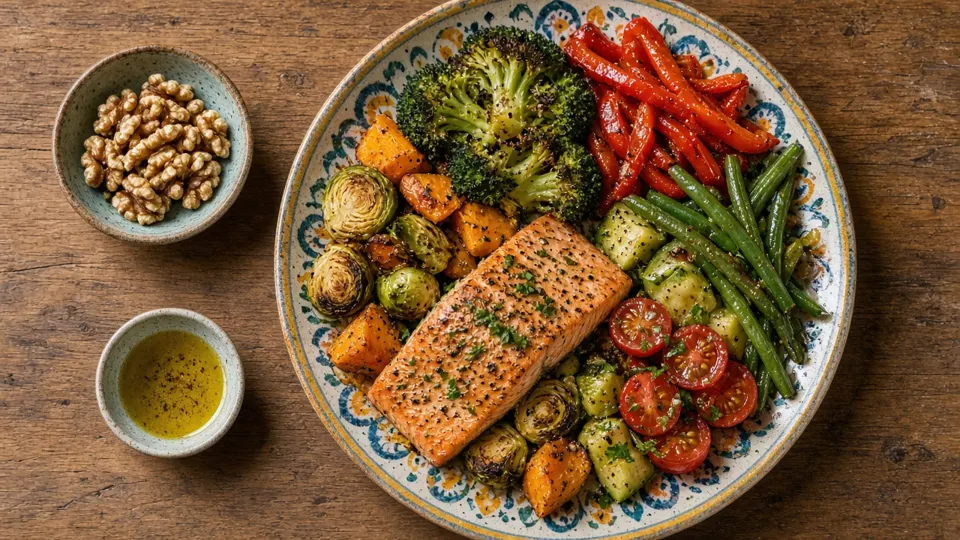
A simple trick is to aim for several colours on the plate: green leaves, red tomatoes or peppers, orange carrots, purple cabbage or berries. Colour usually means variety, and variety means more fibre and micronutrients.
Olive oil and nuts – the PREDIMED evidence
PREDIMED was a large trial in Spain with 7,447 people aged 55 to 80 at high cardiovascular risk. Participants followed a Mediterranean diet with extra-virgin olive oil, a Mediterranean diet with mixed nuts (30 g a day of walnuts, hazelnuts and almonds), or a control diet with advice to reduce fat. In the corrected 2018 report in the New England Journal of Medicine, the rate of major cardiovascular events (heart attack, stroke or cardiovascular death) was about 30% lower in the Mediterranean groups. The original 2013 report was withdrawn because of randomisation problems, and the reanalysis found similar results. The authors also note the results apply to people at high risk and may not generalise to everyone.
The WHO also says unsaturated fats, found in fish, avocado, nuts and in olive, sunflower, soybean and canola oils, are preferable to saturated fats.
Nuts in moderation: in PREDIMED the daily portion was 30 g – roughly a small handful. Nuts are energy-dense, so a handful is a sensible amount rather than a bag.
Less red meat, and especially less processed meat
The WHO's International Agency for Research on Cancer has classified processed meat as Group 1, carcinogenic to humans, and red meat (beef, veal, pork, lamb, mutton, horse and goat) as Group 2A, probably carcinogenic to humans. The traditional Mediterranean diet, as described in the PREDIMED paper, includes a low intake of red and processed meat, with fish and poultry in moderation.
In practice: make beans, lentils, fish or poultry your default protein a few days a week, and treat sausages, bacon and ham as occasional foods.
A week of small swaps
- Swap a soft drink for water or sparkling water.
- Swap a packaged snack for fruit or a small handful of nuts.
- Use olive oil for cooking and dressings.
- Make one dinner a week built around beans or lentils.
- Add one extra vegetable to every dinner.
- Cook a larger batch on the weekend so you have real food ready on busy days.
Food works best together with training (Training) and knowing your values (Biochemistry and values). For a fitness baseline, try the biological age calculator.
FAQ
Are all processed foods bad? No. Minimally processed foods like frozen vegetables, canned beans or plain yoghurt are fine. The concern in the BMJ review is about ultra-processed products.
How many nuts should I eat? PREDIMED used 30 g a day, about a small handful. Check with your doctor if you have a nut allergy.
Is olive oil really better than butter? The WHO says unsaturated fats such as olive oil are preferable to saturated fats, and PREDIMED supports a Mediterranean diet with extra-virgin olive oil in high-risk adults.
Do I have to stop eating red meat? No, but the WHO's cancer agency classifies red meat as probably carcinogenic and processed meat as carcinogenic, so eating less is a reasonable choice.
How much sugar is too much? The WHO recommends less than 10% of daily energy from free sugars.
Full disclaimer
This page is general information, not medical or dietetic advice. If you have a medical condition, allergies, an eating disorder, are pregnant or take medication, talk to your doctor or a registered dietitian before changing your diet. Study results describe groups of people and may not apply to you. Sources were checked in October 2026.
Sources
- Lane MM et al. Ultra-processed food exposure and adverse health outcomes: umbrella review of epidemiological meta-analyses. BMJ 2024;384:e077310: https://www.bmj.com/content/384/bmj-2023-077310
- Estruch R et al. Primary prevention of cardiovascular disease with a Mediterranean diet supplemented with extra-virgin olive oil or nuts (PREDIMED). N Engl J Med 2018;378:e34: https://www.nejm.org/doi/full/10.1056/NEJMoa1800389
- WHO – Healthy diet fact sheet: https://www.who.int/news-room/fact-sheets/detail/healthy-diet
- WHO/IARC – Q&A on the carcinogenicity of red and processed meat: https://www.who.int/news-room/questions-and-answers/item/cancer-carcinogenicity-of-the-consumption-of-red-meat-and-processed-meat

Former elite cyclist, master runner over 5000 m and 10 000 m.
Coaching with Flemming
A training plan with weekly follow-up
Running or cycling. I look at every session you log. First month free, no binding period, via Everfit.
$45 / £45 per month